

The Right AI for the Right Job: Why Purpose-Built Models Matter for Midstream Records
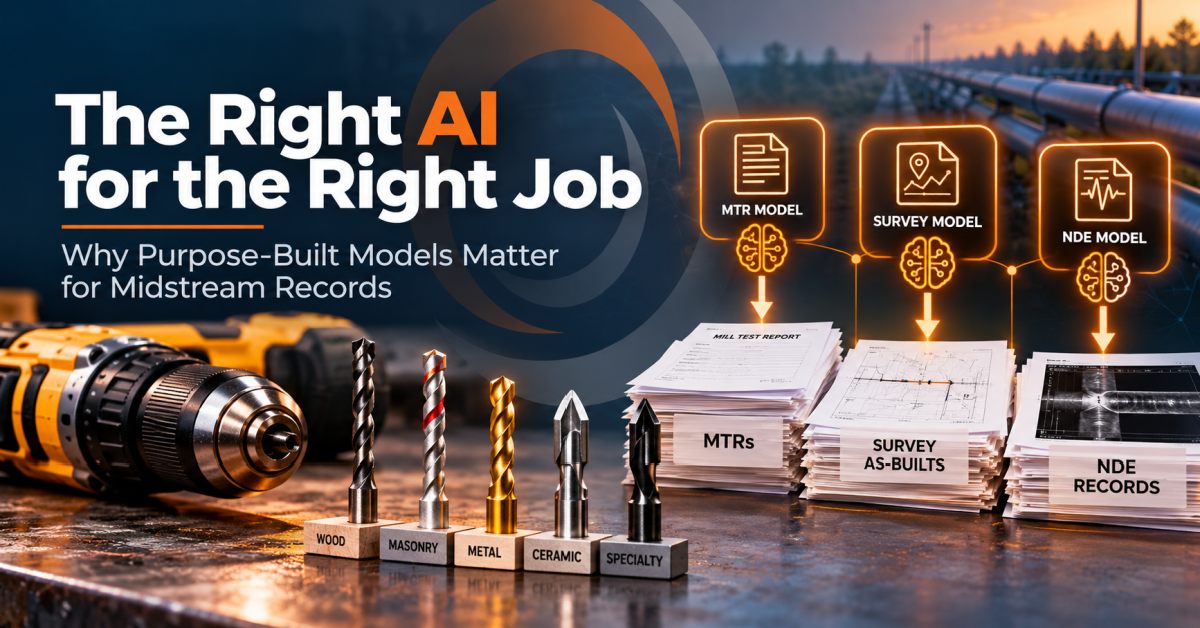
Artificial intelligence is transforming how energy operators manage critical infrastructure records. But just as every drill bit is designed for a particular material, not every AI model is suited to every task. For the midstream industry, the greatest value comes from applying specialized AI models to specific record types, with experienced professionals guiding and validating the results.
A Powerful Tool Is Only as Good as the Person Using It
Imagine walking into a workshop with a powerful cordless drill and a case full of drill bits.
The drill itself is impressive. It can deliver tremendous speed, torque, and efficiency. But its effectiveness depends on something much more fundamental: selecting the right bit for the material and the job.
A wood bit may work beautifully when drilling through lumber, but it is hardly the right choice for titanium. A masonry bit designed for concrete may damage ceramic tile. Even the most advanced drill cannot compensate for using the wrong tool—or for an operator who doesn't understand the material being worked on.
Artificial intelligence operates on a similar principle.
Today's AI technologies offer extraordinary processing capabilities. They can analyze documents, recognize patterns, extract information, and automate tasks that previously required substantial manual effort.
But deploying a powerful AI model without considering its intended application can create more problems than it solves.
For energy operators managing critical infrastructure records, the question is not simply whether AI can process the information. It is whether the AI has been properly trained, configured, and supervised to process that particular type of information accurately.
Why One-Size-Fits-All AI Falls Short
The midstream energy industry generates and maintains an enormous volume of technical documentation throughout the lifecycle of a pipeline or facility.
These records include:
Material Test Reports (MTRs)
Survey as-built drawings
Non-Destructive Examination (NDE) records
Weld logs and inspection reports
Hydrostatic pressure test documentation
Pipe tally and reader sheets
Piping and Instrumentation Diagrams (P&IDs)
Although these documents may all contain information about the same infrastructure, they differ significantly in structure, terminology, formatting, and technical purpose.
An MTR, for example, contains material characteristics and manufacturing information. A survey as-built drawing documents the location and configuration of installed infrastructure. An NDE record provides inspection results associated with weld quality and material integrity.
Each requires a different understanding of the data being presented.
Complicating matters further, records from different manufacturers, contractors, projects, and historical periods often use inconsistent formats. Important information may be buried in scanned PDFs, handwritten notes, legacy forms, or documents that were never designed for automated processing.
A general-purpose AI model may recognize text and extract apparent values. But recognizing a number is not the same as understanding what that number represents, how it relates to a specific asset, or whether it conflicts with another record.
When AI is applied without the necessary industry context, errors can be introduced into datasets that operators rely upon for engineering, integrity management, regulatory compliance, and operational decisions.
In other words, a model that works well for one type of document may be entirely unsuitable for another.
Purpose-Built AI: Matching the Model to the Record
At Vintri Technologies, the approach is to move beyond generalized document processing by fine-tuning AI models for specific midstream industry record types.
Rather than expecting a single model to interpret every document with equal accuracy, specialized models are developed and refined to recognize the characteristics of particular records.
Consider three examples.
Material Test Reports: Understanding Material Traceability
MTRs contain critical information used to establish material identity and verify compliance with applicable specifications.
A purpose-built model can be trained to recognize attributes such as heat numbers, material grades, dimensions, and relevant test results—even when manufacturers organize this information differently.
The objective is not simply to extract text. It is to convert technical documentation into structured information that can be associated with the correct material or pipeline component and subsequently validated.
Survey As-Builts: Connecting Records to Physical Infrastructure
Survey as-built documentation presents a different challenge.
These records may contain coordinates, measurements, annotations, and information describing the physical location of installed infrastructure.
Processing them requires models and workflows suited to the characteristics of drawings and spatial information, rather than those designed primarily for tabular manufacturing reports.
Accurate interpretation helps support the relationship between construction records, physical assets, and the systems operators use to manage them.
NDE Records: Supporting Inspection and Integrity Data
Non-Destructive Examination records introduce yet another set of requirements.
Inspection methods, weld identifiers, examination results, and acceptance information must be interpreted within their appropriate technical context.
A model trained for material certification is not automatically equipped to understand the structure and terminology of an NDE report.
By developing specialized capabilities for these distinct record types, Vintri is working toward more accurate, efficient, and repeatable data extraction across complex midstream documentation.
The underlying principle is straightforward: select and train the AI for the task, rather than forcing every task through the same AI.
Purpose-Built AI for Midstream Records: Specialized AI models process MTRs, survey as-builts, and NDE records, while Expert-in-the-Loop validation helps transform extracted information into accessible, traceable, and trustworthy data. Click the graphic to enlarge.
The Human Expert Still Matters
Returning to the workshop analogy, even the correct drill bit does not guarantee a successful result.
An experienced tradesperson understands the material, selects the appropriate settings, recognizes when something is wrong, and adjusts the approach accordingly.
AI requires similar oversight.
Vintri employs an Expert-in-the-Loop (EITL) approach that combines automated processing with the knowledge of professionals who understand midstream records, material traceability, and data integrity requirements.
In this approach, AI models perform document classification and data extraction, while industry experts help validate results, investigate exceptions, and guide improvements to the models.
This is particularly important when dealing with unusual document formats, incomplete records, conflicting values, or information that cannot be confidently interpreted through automation alone.
Expert supervision creates a continuous improvement process. As models encounter new variations, validated feedback can help refine their performance for future processing.
The result is not fully autonomous AI operating without accountability. It is a combination of machine efficiency and specialized human judgment.
For an industry where data quality has direct implications for safety, compliance, and asset value, that distinction matters.
From Extracted Data to Verified Information
Extracting information from documents is only the beginning.
A pipeline operator may have thousands of records containing values that appear accurate when viewed individually. However, those values must also be consistent with related documents and correctly associated with the infrastructure they describe.
For example, a heat number extracted from an MTR must correspond to the appropriate material. Weld information must align with associated construction and inspection records. Missing documentation and conflicting attributes must be identified before they become downstream problems.
Vintri's broader data management approach addresses these challenges by converting unstructured information into usable, standardized data and applying industry-specific validation and cross-verification processes.
This supports the establishment of a Verified Single Source of Truth (Verified SSoT)—information that is accessible, traceable, and trustworthy.
Importantly, AI-assisted extraction and data verification are complementary processes. Successfully reading a document does not, by itself, establish that the resulting data is complete or correct.
That confidence comes from combining purpose-built extraction, expert review, and systematic validation across related records.
The Business Case: Significant Time Savings Without Sacrificing Oversight
The potential return on investment becomes particularly compelling when operators consider the time required to process large collections of historical records.
In a project example presented by Vintri, approximately 1,500 records were evaluated using different processing approaches.
The reported effort illustrates the opportunity:
| Processing Approach | Reported Processing Time |
|---|---|
| Manual processing | More than 1,000 hours |
| Traditional OCR-assisted processing | More than 100 hours |
| AI with Expert-in-the-Loop | Under 15 minutes |
Processing times from a Vintri project example involving approximately 1,500 records. Results may vary depending on document complexity, quality, and validation requirements.
The presentation also reported confidence levels of 95–99% for the AI-assisted workflow.
These figures represent a specific project example rather than a universal performance guarantee. Actual results depend on the document types, quality, model readiness, validation requirements, and project scope.
Nevertheless, the comparison demonstrates why specialized AI deserves serious consideration.
The objective is not merely to process documents faster. It is to reduce repetitive effort while helping technical specialists focus their attention on exceptions, discrepancies, and decisions that require professional judgment.
For operators managing extensive legacy records, capital projects, or regulatory documentation, the operational benefits can be substantial.
Better Models, Better Decisions, Greater Long-Term Value
The consequences of incomplete or inaccurate records extend far beyond document administration.
Poor data quality can complicate Maximum Allowable Operating Pressure (MAOP) validation, weaken Traceable, Verifiable, and Complete (TVC) documentation, delay project turnover, and create uncertainty during asset acquisitions or divestitures.
Vintri's presentations describe real-world situations in which missing material records and discrepancies created substantial potential exposure for pipeline operators.
These examples reinforce an important lesson: the earlier data quality issues are identified, the more opportunities operators have to address them before they affect construction, compliance, or asset value.
Purpose-built AI can help accelerate that process by making technical information available for verification sooner.
It also creates a foundation for continuous improvement.
As models are refined for different record types, suppliers, and historical formats, operators can progressively improve their ability to process information that previously remained inaccessible in disconnected files and legacy archives.
Industry collaboration can further strengthen these capabilities by helping identify common documentation patterns, exceptions, and data quality challenges.
The Future of AI in Midstream Is Specialized
The energy industry does not need another technology that promises to solve every problem with a single model.
It needs practical solutions that recognize the complexity of its records, the importance of traceability, and the experience required to interpret technical information correctly.
Just as a skilled professional chooses the appropriate drill bit for the material, successful AI implementation begins with selecting the right model for the right application.
For Vintri Technologies, that means fine-tuning models for specific industry records, maintaining expert oversight, and connecting extracted information to the broader processes that establish data integrity.
The future of AI in midstream is not simply about doing more with automation. It is about doing the right things with the right tools and producing information operators can trust.
Put Purpose-Built AI to Work for Your Infrastructure Data
Vintri Technologies helps energy operators transform complex, unstructured records into accessible, traceable, and trustworthy information through intelligent data ingestion, industry expertise, and the vintriCORE data management platform.
Discover how Vintri's AI-assisted workflows and Verified Single Source of Truth approach can support your data integrity, material traceability, and regulatory compliance initiatives.
Schedule a demonstration at vintritech.com/demo or contact sales@vintritech.com.